
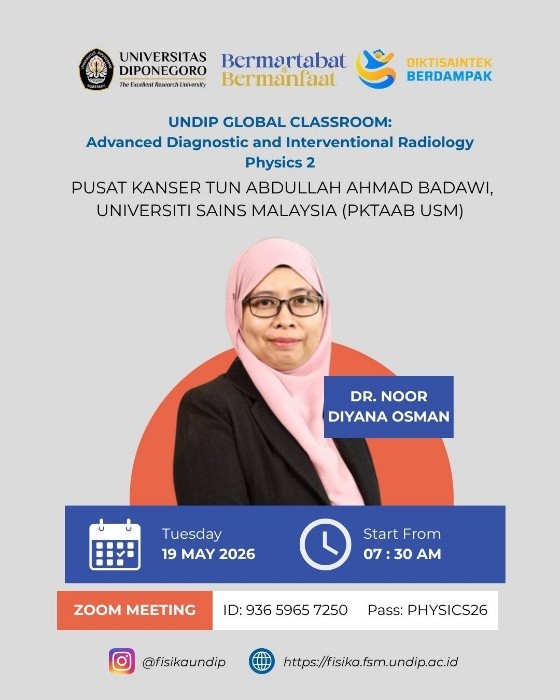
SEMARANG — The Department of Physics, Faculty of Science and Mathematics (FSM) at Diponegoro University (UNDIP) has once again reaffirmed its position as a world-class higher education institution. Through the UNDIP Global Classroom (UGC) 2026 program, the Department of Physics, FSM UNDIP successfully hosted an international academic forum featuring a Medical Physics expert from Malaysia, Assoc. Prof. Dr. Noor Diyana Osman.
This strategic initiative was spearheaded by UNDIP Medical Physics expert, Dr. Choirul Anam, who served as the Person in Charge (PIC) of the program. Carrying the spirit of “Dignified and Beneficial UNDIP” (UNDIP Bermartabat dan Bermanfaat), the series was held virtually via Zoom on May 19 and May 26, 2026, drawing strong engagement from students, academics, and Medical Physics practitioners across the country.
“This program is not merely about bringing international lecturers onto our screens, but rather a transformative step to train our students to think by global standards, understand high-level radiation safety, and prepare them to become leaders in medical technology,” said Dr. Choirul Anam during the event.
Delving Deep into Fluoroscopy & Interventional Radiology Technology In the inaugural session on Tuesday (May 19), Dr. Noor Diyana Osman—a senior academic from the Tun Abdullah Ahmad Badawi Cancer Centre (PKTAAB), Universiti Sains Malaysia (USM)—presented on “Advanced Diagnostic and Interventional Radiology Physics.” She detailed how modern fluoroscopy technology has evolved rapidly from conventional systems to Flat Panel Detector (FPD) technology.
In her presentation, Dr. Diyana explained that FPD technology produces real-time images of internal organs with significantly higher clarity while keeping radiation dose exposure to patients remarkably low. Critical medical procedures such as interventional cardiology, stenting, and angiography were thoroughly examined from a precise medical physics perspective.
The Secrets of Early Breast Cancer Detection via Modern Mammography Equally engaging, the second session on Tuesday (May 26) focused on mammography technology and advanced radiation safety. Dr. Diyana highlighted the critical role of understanding basic physics in early breast cancer detection. The application of a low-energy X-ray spectrum (20–35 kVp) combined with specialized target-filter materials serves as the key to achieving optimal soft-tissue image contrast.
A key highlight of the discussion was the breakdown of 3D Digital Breast Tomosynthesis (DBT) technology. This innovative technology has been proven to increase breast cancer lesion detection accuracy by up to 43 percent compared to conventional mammography by overcoming tissue overlapping challenges.
Dynamic Discussions and Tangible Impact for Students The virtual public lecture was vibrant and highly interactive. Dozens of participants raised critical questions, ranging from maximum skin dose calculation protocols for patients undergoing prolonged surgeries and image optimization for obese patients, to quality control (QC) procedures for hospital radiology equipment.
The presence of UGC 2026 not only enriches students’ theoretical knowledge in the classroom, but also bridges the academic curriculum with international clinical practice standards in modern hospitals. Moving forward, this collaboration between UNDIP and USM Malaysia is targeted to expand into joint research and globally reputable scientific publications.