
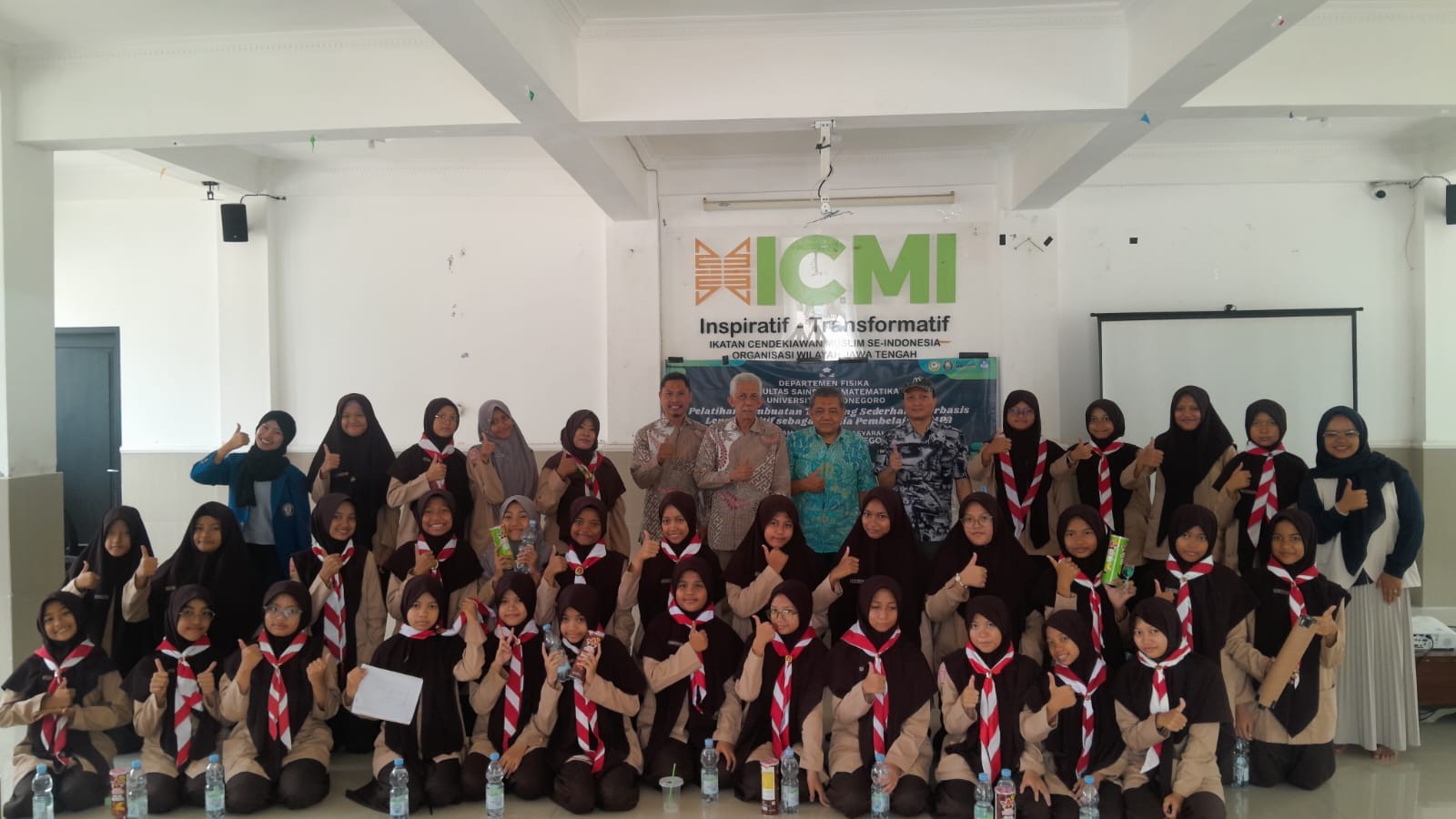
A simple telescope is an optical device made from two convex lenses, and 33 seventh-grade students at SMP Tahfidzul Qur’an Pangeran Diponegoro in Semarang built and tested their own with lecturers from Diponegoro University (UNDIP). The workshop on Thursday, October 8, 2026, produced telescopes with a magnification of nearly four times.
Simple Telescope Workshop at a Semarang Junior High School
The training, titled “Making a Simple Telescope Based on Positive Lenses as a Science Learning Medium,” took place in Kramas Village, Tembalang District. It brought together 33 seventh-grade students and two teachers. The community service team from the Department of Physics, Faculty of Science and Mathematics, UNDIP, used hands-on learning. Students studied the basics of optics while assembling and using the device themselves.
Ali Khumaeni coordinated the program together with Professor Wahyu Setia Budi, Asep Yoyo Wardaya, and Ketut Sofjan Firdausi. Five UNDIP physics students helped participants during assembly and testing. A school representative, Ibnu, opened the event. Ketut Sofjan Firdausi explained how a telescope works, while Ali Khumaeni and Asep Yoyo Wardaya led the building demonstration.
How a Simple Telescope Works With Two Convex Lenses
The device uses two convex lenses with different focal lengths. A lens with a 30 centimeter focal length serves as the objective lens, and a lens with an 8 centimeter focal length acts as the eyepiece. Together they give a theoretical angular magnification of three and three-quarters, which is close to four times.
The other materials are cheap and easy to find: a used shuttlecock container and cardboard. Students worked step by step, from learning about lens characteristics to arranging the optical parts, building the tube, and testing the finished telescope. Then they used it to look at objects around the school.
Benefits of Hands-On Science Learning for Students and Teachers
The workshop was lively, with students asking questions and trying out their own work. Observations and participant feedback in the activity report show that the practice helped students grasp the properties of convex lenses and how images are magnified. It also built their skills in observation, teamwork, and problem solving.
For teachers, the activity introduced an affordable science teaching aid that is easy to develop. The school can keep using it in future lessons.
Outcomes and Next Steps for the UNDIP Physics Department
The program, prepared since August 2026, is part of UNDIP’s community service duty under the Tri Dharma of higher education. Its outputs include the teaching aid and a guidebook on building telescopes from positive lenses, documented as intellectual property. The department hopes to continue working with schools through more workshops on simple technology.
Source: this activity was carried out by the community service team of the UNDIP Department of Physics. Campus information is available at Diponegoro University.