
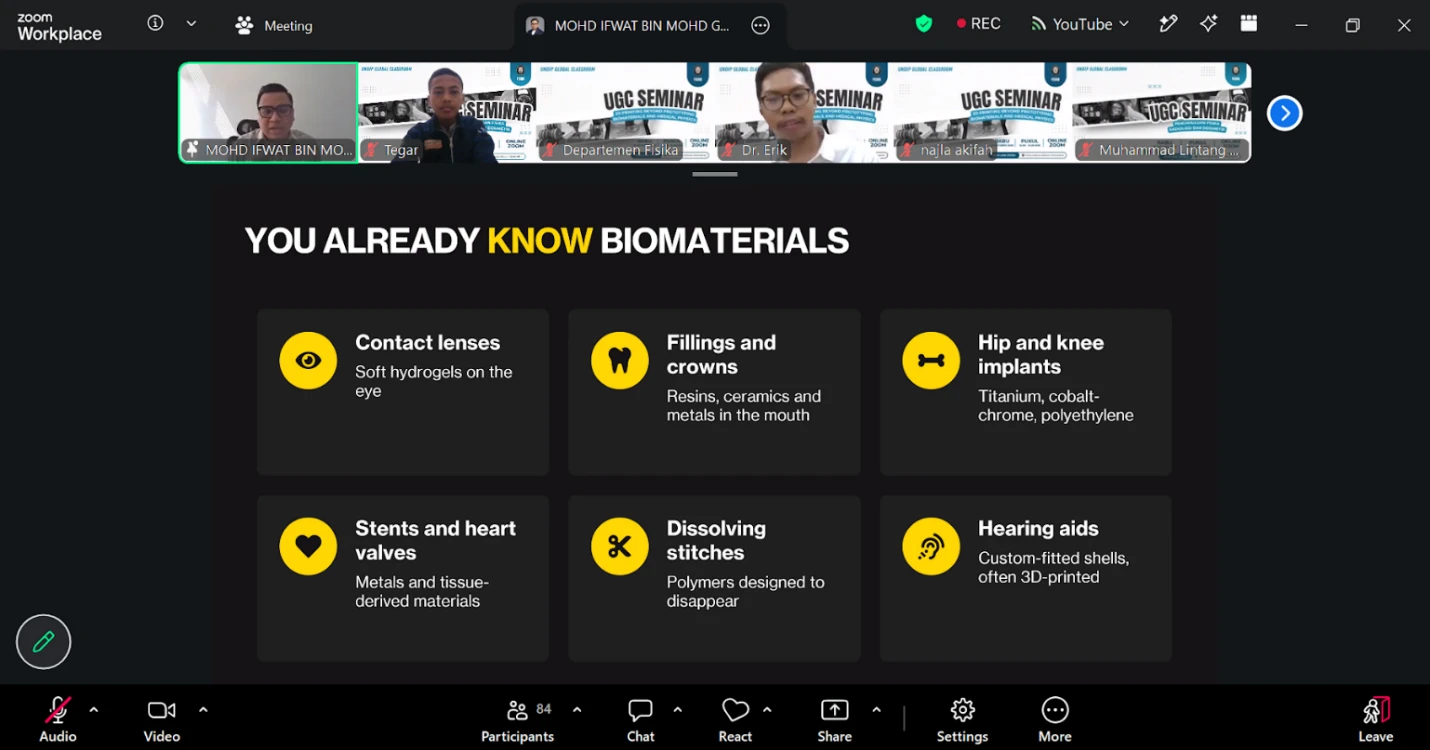
The UNDIP Global Classroom held by the Department of Physics at Universitas Diponegoro explored 3D printing for biomaterials and medical physics on Wednesday, 28 October 2026. The online seminar featured Dr Mohd Ifwat bin Mohd Ghzali from Universiti Malaya, Malaysia. He explained that 3D printing technology can now go far beyond making prototypes.
What Is the UNDIP Global Classroom
The UNDIP Global Classroom, or UGC, is an international guest lecture program run by the Department of Physics, Faculty of Science and Mathematics, UNDIP. The program invites academics from overseas universities to deliver course material. This session took place on Zoom under the title 3D Printing Beyond Prototyping: Biomaterials and Medical Physics. It also supports the World Class University program at UNDIP.
The online format lets the department bring in experts from abroad without flying them to Semarang. Students only need a Zoom link to attend lectures from academics at other universities.
Universiti Malaya is not the only Malaysian university involved. Throughout 2026, the UGC program at UNDIP Physics has also hosted lecturers from Universiti Sains Malaysia, Universiti Kebangsaan Malaysia and Universiti Teknologi Malaysia.
3D Printing Is No Longer Just for Prototypes
The seminar highlighted how the role of 3D printing, also known as additive manufacturing, has shifted. Additive manufacturing builds objects layer by layer from a digital model. In the past, the technology was mostly used to make product samples. Today it can produce three-dimensional structures with complex geometry. The properties of each printed part can also be tuned to specific needs.
The process works the opposite way to conventional machining, which cuts material away from a solid block. A 3D printer adds material bit by bit until the final shape is complete. That makes it possible to build internal cavities or porous patterns in a single print.
For researchers, a design can be changed on a computer and printed again right away. Shapes that were hard to make with molds or lathes are now much easier to produce.
3D Printing Opportunities in Biomaterials and Medical Physics
This capability opens the way for new biomedical materials and medical devices. Biomaterials are materials designed to interact with body tissue. The technology also supports a wide range of health research. Physics, materials science and biomedical engineering meet in one process to answer the needs of modern medicine.
No two patients have exactly the same needs. Bone size, organ shape and tissue condition vary from person to person. Three-dimensional printing makes it possible to match the shape and properties of a material to those conditions.
This is where medical physics comes in. The field applies physics concepts to medicine, including how materials respond to force, heat and radiation. That knowledge decides whether a printed material is safe and fit for use in healthcare.
Encouraging Interdisciplinary Research Among Students
The expert from Universiti Malaya gave UNDIP physics students a direct look at advanced manufacturing and its use in healthcare. The department hopes the session will spark interest in cross-disciplinary research. One example is work that combines physics concepts, materials characterization and medical technology innovation.
Materials characterization means measuring the properties of a material, such as its strength, crystal structure or density. Physics students already learn these skills in the lab. The seminar showed that the same skills can carry over into research on medical devices.
International Network of the UNDIP Department of Physics
The UGC program also strengthens international academic networks and opens doors for collaboration in teaching and research. Through it, the Department of Physics aims to build an innovative academic culture with a global outlook.
News on similar events is available on the Department of Physics at Universitas Diponegoro website, and more about the speaker’s institution is on the official Universiti Malaya website.