Semarang, May 20, 2026 — The Department of Physics, Faculty of Science and Mathematics (FSM), Diponegoro University (UNDIP) has once again demonstrated its ongoing commitment to delivering an open, global, and impactful physics education through its flagship initiative, the Undip Global Classroom (UGC). The program was successfully conducted over two virtual international sessions on Monday, May 18, 2026, and Wednesday, May 20, 2026, featuring a prominent guest speaker from Thailand.
In the first installment of the series, the UGC program raised the topic of “Fundamentals of Thermodynamics.” This session served as an essential introduction, helping participants grasp the foundational principles of thermodynamics as one of the major pillars of physics. Two days later, the second session continued with “Thermodynamics and Its Applications,” broadening the discussion from foundational theories toward real-world implementations in daily life, technology, energy sectors, manufacturing industries, environmental protection, and modern research.
The university invited Dr. Vikas Rathore from Walailak University, Thailand, as the keynote speaker, while the interactive discussions were moderated by Dr. Rina Dwi Indriana from Diponegoro University. The presence of an international expert provided a broader academic experience for the audience, fostering a global space for interaction that enriched the horizons of university students, high school pupils, and the wider academic community regarding advancements in physics worldwide.
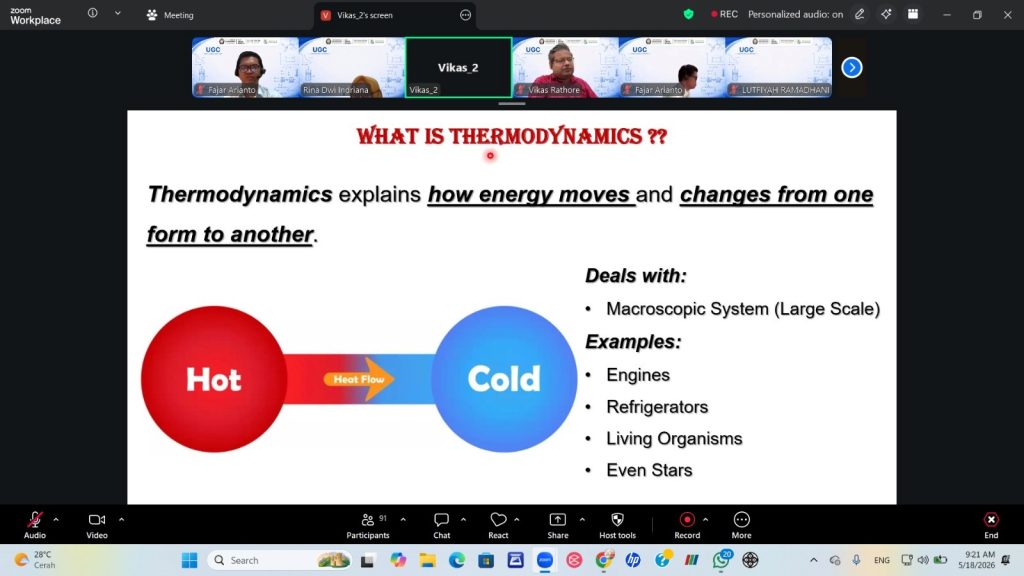
Through this two-part series, the Department of Physics did not merely present thermodynamics as an abstract classroom subject, but rather as a foundational science that operates very close to daily human experience. Thermodynamics governs the relationship between heat, energy, work, temperature, and the changes in a system’s state. This core concept serves as the absolute foundation for numerous innovations—ranging from combustion engines, air conditioning units, and power plants to advanced materials technology, renewable energy systems, atmospheric science, and even biological processes within the human body.
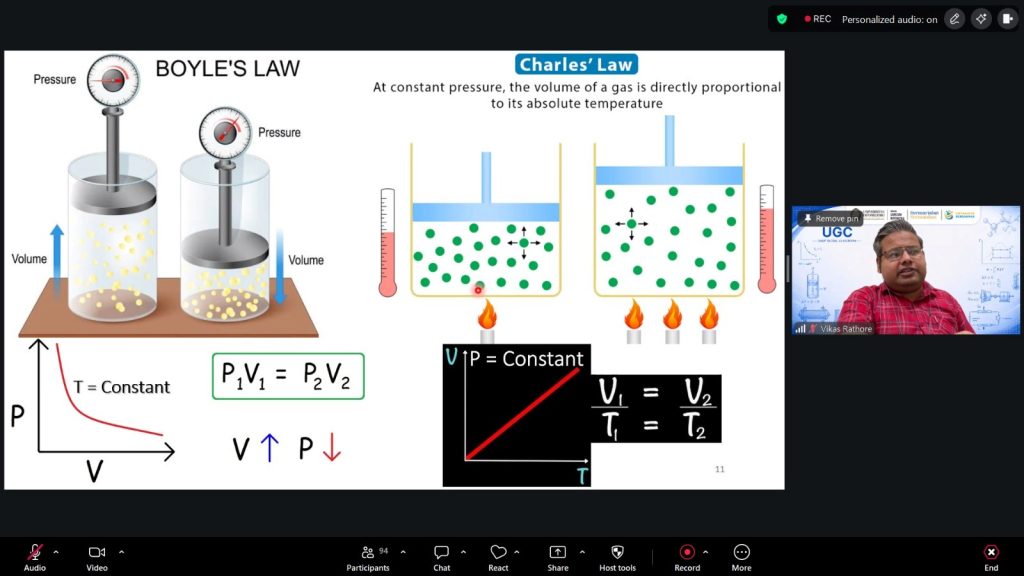
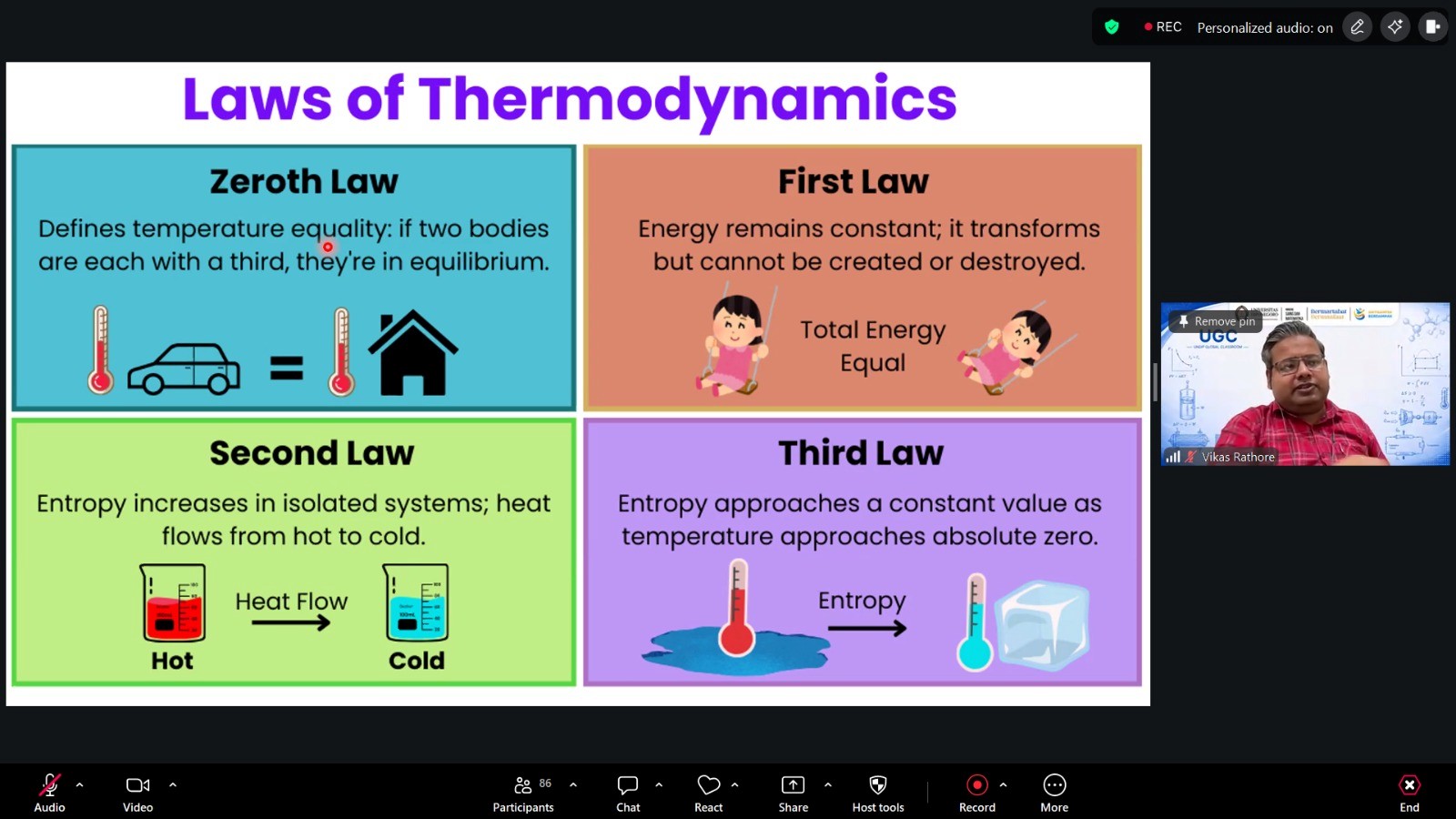
During the first webinar, participants were guided step-by-step through fundamental concepts such as thermodynamic systems, surroundings, temperature, heat, internal energy, work, and the basic laws of thermodynamics. Mastering these fundamentals is crucial, as they explain how energy is transferred, how physical systems evolve, and why natural processes always flow in specific directions. Armed with this conceptual clarity, attendees could see that physics is not a mere collection of mathematical formulas, but a powerful scientific mindset to read the structural order of the universe.
The introductory session also highlighted how thermodynamics functions as a scientific language to explain commonplace phenomena. It answers everyday questions—such as why water boils when heated, why engines require fuel to perform mechanical work, how refrigerators keep food cold, and why energy cannot be created out of nothing. Consequently, participants gained a profound appreciation for the relevance of physics in real human experiences.
The second session shifted gears toward practical implementations across various modern sectors. The discussion on “Thermodynamics and Its Applications” illustrated that physics contributes significantly to addressing today’s pressing global challenges. Amidst concerns surrounding energy crises, climate change, industrial efficiency, and the demand for eco-friendly technologies, thermodynamics stands as an indispensable discipline. Developing deep insights into energy efficiency, thermal-to-mechanical conversion, and renewable energy deployment mandates a robust understanding of thermodynamic systems.
The event served as a solid testament that studying physics means learning to understand global challenges on a deeper level. The discipline does not stop at whiteboards, laboratories, or text books; it actively works behind the cooling systems, aircraft engines, solar panels, power grids, batteries, sensors, medical devices, and communication networks that sustain modern civilization.
For high school students (SMA/MA/SMK) currently seeking their future path in higher education, initiatives like the UGC vividly showcase that the Department of Physics at FSM UNDIP offers an engaging, dynamic, and highly prospective learning environment. Here, students are not only trained to understand theories but are also equipped to think critically, conduct experiments, analyze data, solve complex problems, and engineer science-based innovations. These analytical skills are highly sought-after across research, academia, industry, technology, healthcare, and computational fields.
While physics is often perceived as a daunting subject due to its heavy use of mathematical equations, this UGC event successfully invited participants to see its vibrant, living side. Mathematical formulas are not the final destination; they are simply tools to translate natural phenomena. Behind every equation lies a compelling story about nature, energy, motion, light, heat, and technological progress. When students comprehend the meaning behind these concepts, physics transforms into an exciting and challenging journey.
The Department of Physics at FSM UNDIP constantly strives to cultivate a sense of wonder and high curiosity toward science among the youth, recognizing that physics is a primary cornerstone of technological leaps. History shows that monumental innovations stem from simple questions about nature. Inquiries into heat led to steam engines and modern power systems; questions about light birthed optics, lasers, cameras, and fiber-optic communication; investigations into atoms generated materials physics, nanotechnology, and semiconductors; while questions about the cosmos brought forth astrophysics and space observation technology.
Furthermore, the virtual classroom allowed participants to experience a genuine international academic atmosphere. Learning directly from an overseas lecturer offered a unique experience, exposing participants to global academic perspectives, methodologies, and cultures. This aligns perfectly with Diponegoro University’s overarching mission to expand its global network and continuously host prestigious, beneficial academic programs with a real impact on society.
The smooth execution of the event via Zoom Meetings also highlighted how science education can transcend physical boundaries, reaching a wider audience without geographical limits. The digital format enabled university students, high schoolers, lecturers, and science enthusiasts from various regions to participate equally, proving that digital technology can successfully democratize access to high-level international knowledge.
For the internal students of UNDIP’s Physics Department, this webinar series provided an invaluable opportunity to strengthen their scientific mastery while sharpening their communication skills in an international forum. It pushed them to comprehend lectures delivered in English, digest scientific concepts from international scholars, and build the confidence necessary to engage in global academic discourse—an essential asset for nurturing adaptive, competitive graduates who are ready for both international career landscapes and advanced postgraduate studies.
Meanwhile, for prospective students, the event served as a window into the highly active and globally connected academic climate at FSM UNDIP. Physics at UNDIP is not taught merely as a basic theory, but is rigorously developed into various applied branches tailored for future needs, including materials physics, instrumentation, energy studies, computational physics, geophysics, optics, and science-based technology.
Ultimately, the two-part UGC series sent a powerful message: the future demands a generation that is conceptually grounded yet highly creative in applying knowledge. Challenges surrounding energy security, climate change, sustainable development, and industrial innovation are deeply inseparable from the mastery of basic sciences. Therefore, studying physics is a highly strategic intellectual investment.
The Department of Physics at FSM UNDIP hopes that the UGC program will inspire all participants to foster a lifelong passion for learning, the courage to ask questions, and perseverance in understanding science. Physics teaches that every phenomenon has an explanation, every problem can be systematically analyzed, and every limitation can mark the beginning of a new discovery.
Through this successful international initiative, the Department of Physics at FSM UNDIP reaffirms its strategic role as a leading higher education institution that looks beyond regular classrooms, focusing intently on global academic networking, the internationalization of education, and the widespread dissemination of knowledge for the public good.
The department extends an open invitation to the younger generation to fearlessly embrace physics. It is a discipline that shapes logical, systematic, and creative thinking—helping humanity comprehend the universe, advance technology, and pioneer solutions for a better tomorrow. For students with profound curiosity who welcome intellectual challenges, the Department of Physics at FSM UNDIP stands as the ideal gateway to build a bright and meaningful future.