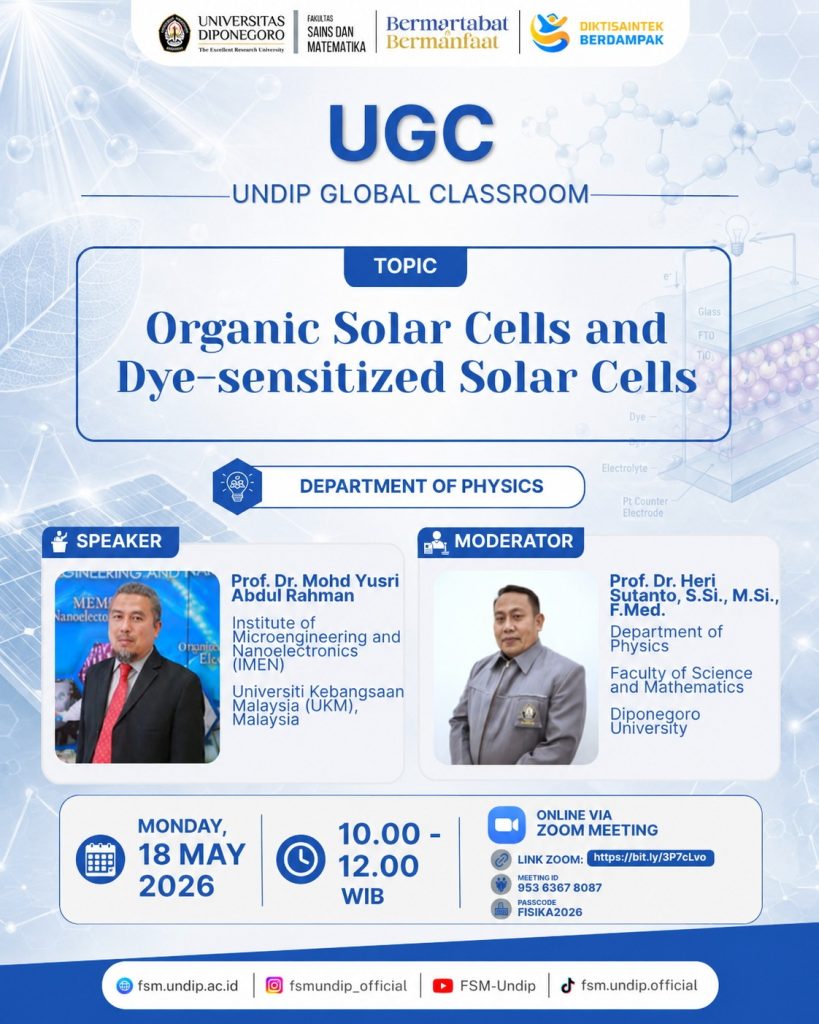
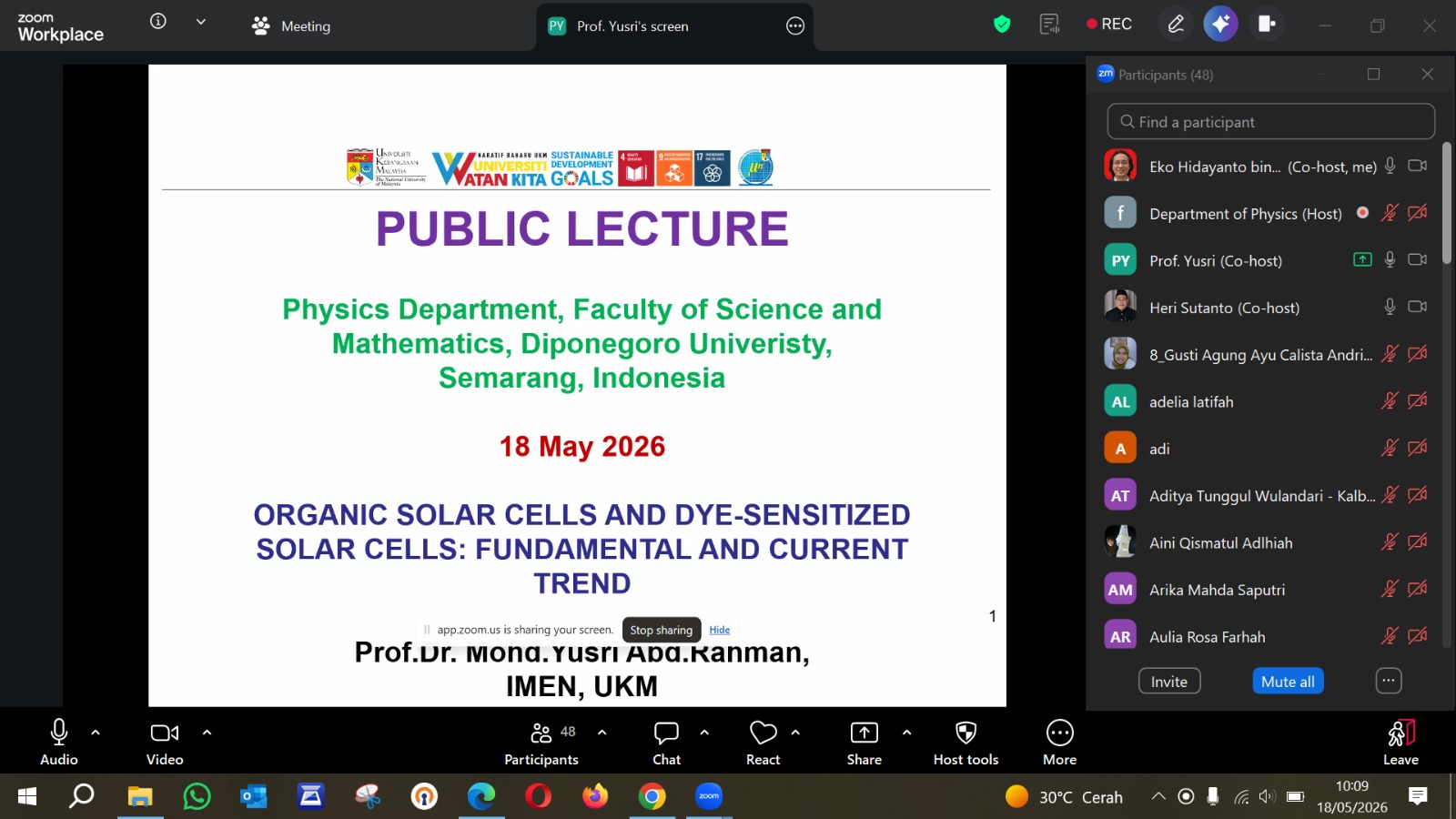
Semarang – The Department of Physics, Faculty of Science and Mathematics (FSM), Universitas Diponegoro (UNDIP), successfully hosted the UNDIP Global Classroom (UGC) virtually on Monday, May 18, 2026. Featuring the theme “Organic Solar Cells and Dye-Sensitized Solar Cells: Fundamental and Current Trend,” the event brought in Prof. Dr. Mohd. Yusri Abd. Rahman from the Institute of Microengineering and Nanoelectronics (IMEN), Universiti Kebangsaan Malaysia (UKM), as the keynote speaker. The session was moderated by Prof. Heri Sutanto and attended by lecturers, researchers, and students from various institutions.
This UNDIP Global Classroom event was the result of an academic collaboration initiated by Prof. Eko Hidayanto, who has maintained long-standing cooperation and collegial relationships with Prof. Yusri through various academic and research activities. Prof. Yusri’s presence is expected to further strengthen Universitas Diponegoro’s international network while opening up opportunities for research collaboration in advanced materials, nanotechnology, and renewable energy.
In the public lecture, Prof. Yusri presented advancements in third-generation solar cell technology, specifically Organic Solar Cells (OSCs) and Dye-Sensitized Solar Cells (DSSCs), which are currently among the primary focuses of global research in supporting the transition to clean energy. Compared to conventional silicon-based solar cells, OSCs and DSSCs offer multiple advantages, such as relatively simple fabrication processes, lower production costs, the use of more environmentally friendly materials, and the potential to develop flexible, lightweight, and semi-transparent devices.
The material began with an explanation of the evolution of solar cell technology from the first to the third generation, followed by an in-depth discussion on device structures and charge transport mechanisms in both OSCs and DSSCs. For DSSCs, Prof. Yusri explained the critical roles of each component—namely the photoanode, dye-sensitizer, electrolyte, and counter electrode—which work in an integrated manner to convert light energy into electricity through an efficient electron transfer process.
In addition to the fundamental aspects, participants were introduced to various characterization techniques used to evaluate solar cell performance. These methods included current-voltage ($J-V$) measurements under a standard light intensity of 100 mW/cm² to determine photovoltaic parameters, Electrochemical Impedance Spectroscopy (EIS) to analyze resistance and charge transfer processes, Incident Photon-to-Current Conversion Efficiency (IPCE) to measure the efficiency of converting photons into electrical current, as well as Cyclic Voltammetry (CV) and Tafel Polarization to evaluate the electrocatalytic activity of electrode materials.
Prof. Yusri also presented recent research findings on the utilization of metal alloy materials as alternative counter electrodes to replace platinum in DSSCs. Various alloy-based materials, such as PdAu and PdNb, demonstrate competitive performance at a more economical cost, opening up avenues for developing more efficient and sustainable DSSCs. Furthermore, the development of flexible DSSCs featuring high mechanical flexibility and long-term stability drew significant interest from the audience due to their potential to support next-generation electronic devices.
The highly interactive discussion reflected the participants’ strong enthusiasm for the advancement of third-generation solar cell technology and its applications in supporting renewable energy development. Through this forum, attendees gained a comprehensive understanding of both the challenges and research opportunities in the rapidly evolving field of photovoltaic materials.
By organizing the UNDIP Global Classroom, Universitas Diponegoro reaffirms its commitment to strengthening the internationalization of higher education through knowledge exchange with world-class academics. This activity is expected not only to broaden the academic community’s insights into cutting-edge science and technology but also to serve as a strategic step in deepening research collaboration between Universitas Diponegoro and Universiti Kebangsaan Malaysia, particularly in renewable energy, functional materials, and nanotechnology.