
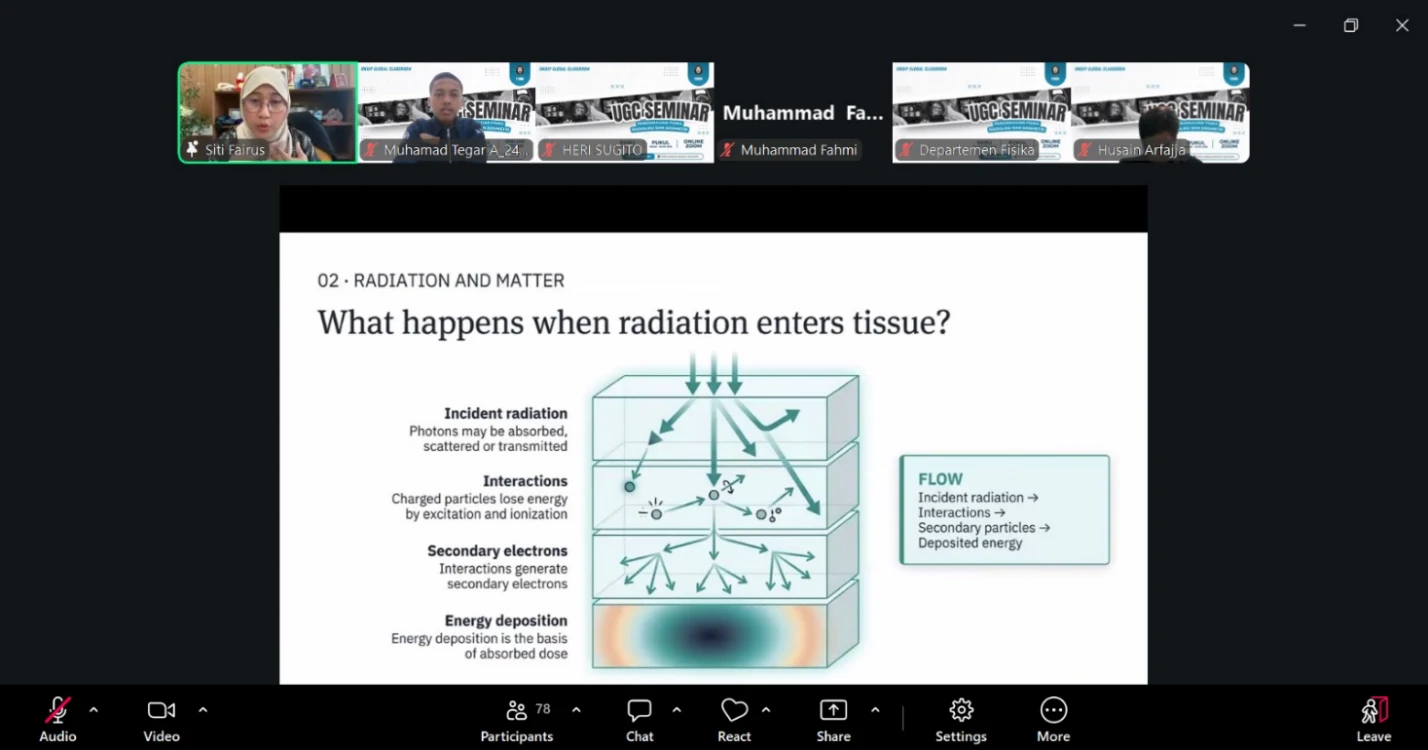
The UNDIP Global Classroom held by the Department of Physics at Universitas Diponegoro covered radiology physics and radiation dosimetry on Wednesday, 28 October 2026. The online guest lecture featured Associate Professor Dr Siti Fairus Abdul Sani from Universiti Malaya, Malaysia. She explained how both fields shape the quality of medical imaging as well as the safety of patients and health workers.
What Is the UNDIP Global Classroom
The UNDIP Global Classroom, or UGC, is an international guest lecture program run by the Department of Physics, Faculty of Science and Mathematics, UNDIP. The program invites academics from overseas universities to deliver course material. This session took place on Zoom under the topic Introduction to Radiology Physics and Dosimetry. It also supports the World Class University program at UNDIP.
The online format lets the department bring in experts from abroad without flying them to Semarang. Students only need a Zoom link to attend.
Late October was a busy week for ties with Universiti Malaya. On 27 October, UGC covered simple harmonic motion with a UM academic. On the same day as this session, UGC also hosted another UM expert to discuss 3D printing for biomaterials and medical physics.
What Is Radiology Physics
Radiology physics studies the physical principles behind medical imaging technology. Exams such as X-ray images and CT scans rely on X-rays passing through the body. Different tissues absorb different amounts of these rays, so bone, organs and air spaces stand out in the image.
An understanding of physics helps set the equipment correctly. Beam energy, exposure time and the distance from the source to the patient all affect image sharpness.
Radiation Dosimetry and Dose Measurement
Radiation dosimetry is the study of how to measure and determine radiation dose. Dose describes how much energy the body or a material absorbs. Absorbed dose is usually expressed in gray, while effective dose, which accounts for the sensitivity of each organ, is expressed in sievert.
The measuring instrument is called a dosimeter. Staff in radiology rooms usually wear personal dosimeters to record the exposure they receive at work.
Dosimetry data matters for patients too. With it, hospitals can make sure each exam uses a dose that suits the diagnostic need.
Image Quality and Radiation Safety
Both fields form the basis for optimizing image quality, the accurate use of radiation, and the safety of patients and medical staff. A higher dose often produces a clearer image, but it also raises the risk to the body.
The principle of radiation protection calls for the lowest dose that still gives doctors a readable image. Finding that balance is a core task for medical physicists in hospitals.
Medical Physics Research Opportunities for Students
The Universiti Malaya academic gave UNDIP physics students and staff a view of how physics applies to healthcare, especially radiology technology and radiation protection. The department hopes the session will build interest in medical physics research.
The field keeps growing as health technology advances. Every new imaging device needs updated methods for dose measurement and quality testing.
International Network of the UNDIP Department of Physics
The UGC program strengthens international academic networks and opens doors for collaboration in teaching and research. Through it, the Department of Physics aims to build an innovative academic culture with a global outlook.
News on similar events is available on the Department of Physics at Universitas Diponegoro website, and more about the speaker’s institution is on the official Universiti Malaya website.