
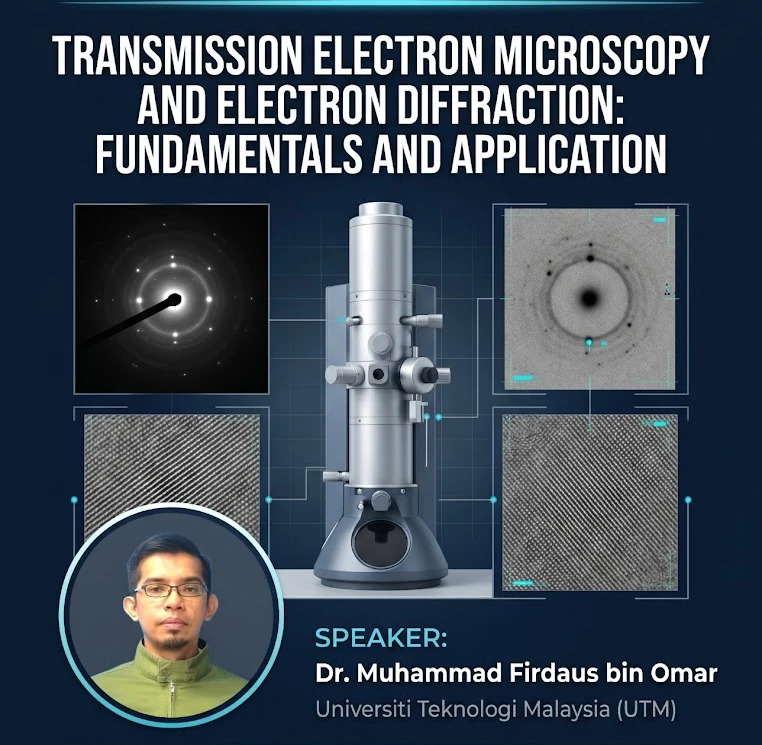
The UNDIP Global Classroom held by the Department of Physics at Universitas Diponegoro covered electron microscopy and electron diffraction on Thursday, 3 September 2026. The guest lecture featured Dr Muhammad Firdaus bin Omar from Universiti Teknologi Malaysia, or UTM. He explained how both techniques can reveal the structure of materials down to the atomic scale.
What Is the UNDIP Global Classroom
The UNDIP Global Classroom, or UGC, is an international guest lecture program run by the Department of Physics, Faculty of Science and Mathematics, UNDIP. The program invites academics from overseas universities to deliver course material. This session was titled Transmission Electron Microscopy and Electron Diffraction: Fundamentals and Application. It also supports the World Class University program at UNDIP.
Many UGC sessions take place on Zoom, but this one was held in person in Room G203. Students heard the speaker directly in the lecture hall.
UTM has taken part in the program before. In May 2026, UGC hosted Associate Professor Raja Kamarulzaman Raja Ibrahim from UTM for a lecture on modern optics.
How Transmission Electron Microscopy Works
The seminar covered the basic principles of Transmission Electron Microscopy, or TEM. Instead of light, this microscope fires a beam of electrons through the sample. TEM lets researchers observe the internal structure of a material down to the nanometer scale. Under certain conditions, it can even reach atomic resolution.
The wavelength of an electron is far shorter than that of visible light. That is why this type of microscope can separate details too small for an ordinary optical microscope.
Samples for TEM must be made very thin so the beam can pass through them. The image forms from the particles that travel through the sample, so researchers see the inside of a material, not just its surface.
Diffraction to Read Crystal Structure
Diffraction is used to gather information on crystal structure, crystallographic orientation and the order of atomic arrangements. As the beam passes through a crystal, planes of atoms bend it and form a distinct pattern on the detector.
That pattern works like a fingerprint for the material. A single crystal usually gives a pattern of spots, a polycrystalline material forms rings, and an amorphous material shows only a blurred pattern. From the spacing of the spots or rings, researchers can calculate the distance between atomic planes.
A single TEM instrument can switch between imaging mode and diffraction mode. The shape of a material and its atomic arrangement can therefore be studied from the same sample.
The Role of Electron Microscopy in Advanced Materials Research
Both techniques play a part in advanced materials research, nanotechnology and the development of devices based on functional materials. Functional materials are designed for a specific task, such as conducting electricity, storing energy or responding to light.
The properties of such materials depend heavily on their atomic arrangement and the defects in their crystals. Without a tool that can see down to the nanometer scale, researchers struggle to explain why one sample performs better than another.
Research Skills for Physics Students
The UTM academic gave UNDIP physics students and staff a view of the characterization methods used in modern research. The department hopes the lecture will strengthen their grasp of materials physics and their understanding of microstructure analysis and crystallography.
The session is also expected to build student interest in materials and nanotechnology research. Concepts taught in crystallography classes now have a visible link to the instruments used in research labs.
International Network of the UNDIP Department of Physics
The UGC program strengthens international academic networks and opens doors for collaboration in teaching and research. Through it, the Department of Physics aims to build an innovative academic culture with a global outlook.
News on similar events is available on the Department of Physics at Universitas Diponegoro website, and more about the speaker’s institution is on the official Universiti Teknologi Malaysia website.